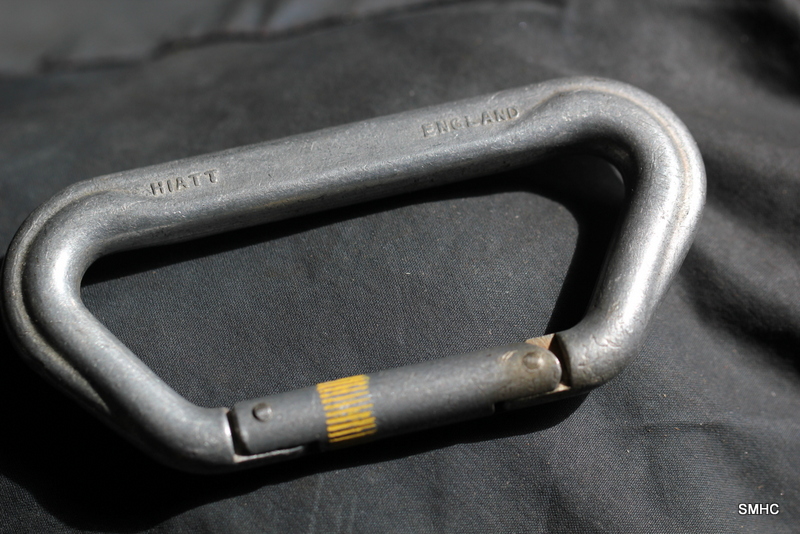
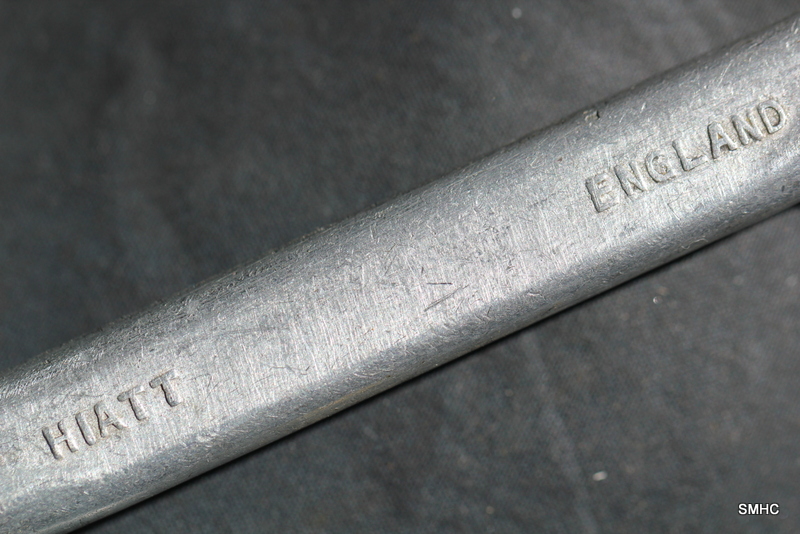
Though there is a little confusion about the spelling, it seems that a Mr Hiat(t) started producing prisoner’s handcuffs, felon’s leg irons, gang chains and collars in Birmingham around 1780. Fortunately, the leg irons, gang chains and collars were soon consigned to history, though Hiatt as a company survived for over 200 years as one of Britain’s, and the world’s, leading providers of handcuffs. The factory closed in 2008, though it seems ‘Hiatt’ still survives under new ownership since Hiatt products are still available in 2013.
Unsurprisingly, for a company that specialised in high quality steel restraint devices, they diversified a little at some point to produce pitons and karabiners. We don’t have any direct information of when this came about, but the early karabiners seemed to have appeared in the late 1950s with the British Mountaineering Council approving the large ‘D’ shaped karabiner in 1963.
We suspect that this type of karabiner came along a little later and, being made from an aluminium alloy, made it lighter and rather more user friendly. Interestingly, this ‘Hiatt’ seems to be an almost exact replica of a Stubai karabiner from the same era.