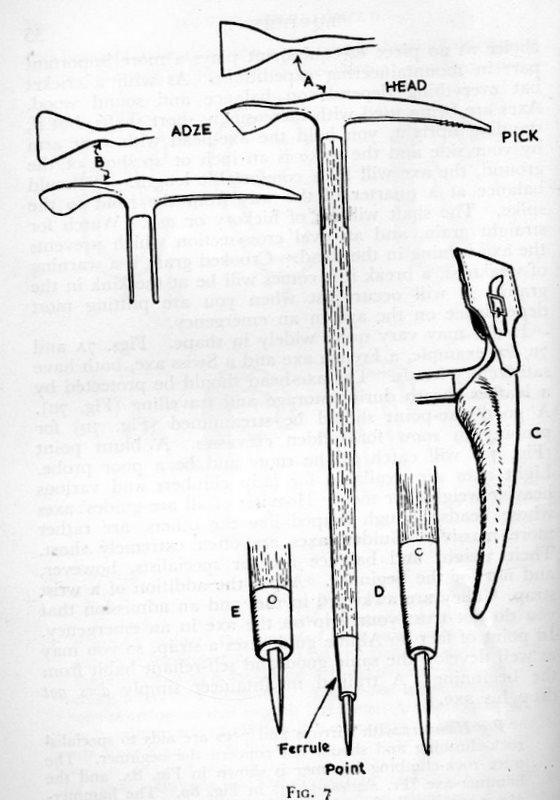
Diagram from 1958 ‘Teach Yourself Mountain Climbing’
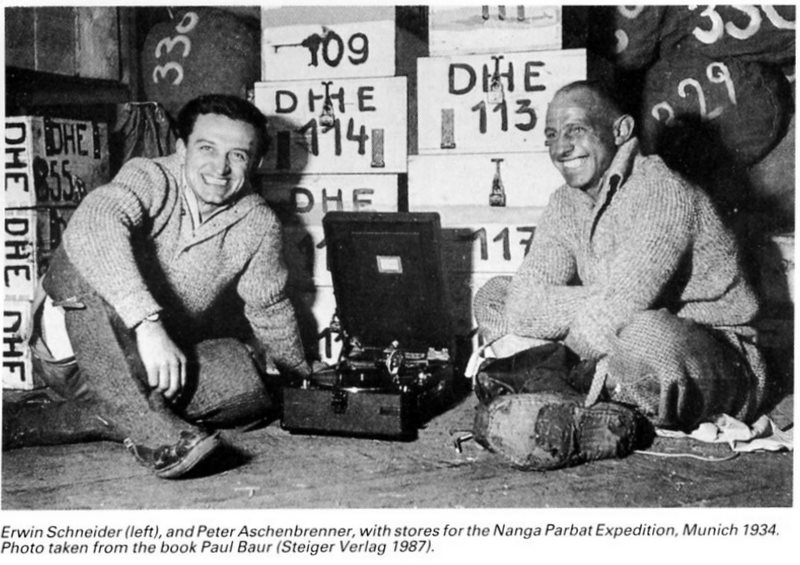
Photo from March/April 1988 ‘Mountain’ magazine No 120
Advert from the Journal of The Fell and Rock Climbing Club 1936/37
Description
‘Stubai’ ice axe, steel head, wooden shaft, adze, serrated pick. Metal ring around wooden shaft, remains of wrist leash attached. Screw, in wooden shaft, to prevent metal ring coming away from axe. Pointed spike on ferrule.
Inscription description
Stamped on serrated blade: Stubai logo and “MADE IN AUSTRIA, ORIGINAL ASCHENBRENNER GES.GESCH” On reverse “ROBERT LAWRIE LTD LONDON W1”
Peter Aschenbrenner was an Austrian Mountain Guide (1902-1998) who was somewhat controversially involved in early expeditions to climb Nanga Parbat in the Himalaya. The German led – and Hitler backed – expedition of 1934 ended in disaster when several Sherpas perished, the result being that Aschenbrenner and fellow expedition member Schneider were hauled before a ‘court of honour’ for ‘abandonment’ of Sherpas and were excluded from further expeditions to Nanga Parbat. This was later rescinded and he was back in 1953 taking over the role of expedition leader from Karl Harrligkoffer. On this occasion, Herman Buhl made the summit alone, to claim the first ascent and though the expedition had technically been a success there was much acrimony.
Aschenbrenner left behind a much less controversial legacy in the form of an ice axe which he developed in the early 1930s and got the Stubai company to manufacture for him. These axes became almost universal in the mountains from the mid 1930s right up to the 1960s when metal and alloy shafted tools began to take over. There were many variations and it seems that some were custom made. Batches were made for German mountain troops during WWII and thousands were exported to the UK, mostly just after WWII, many of which have found their way into our collection.
Robert Lawrie was a bespoke bootmaker for whom one needed an appointment! In this case he would also have been the retailer of this Stubai ice-axe and has taken the opportunity to stamp his name on the head.